When the Lights Go Down: Closing the Visibility Gap in Overnight Fleet Operations
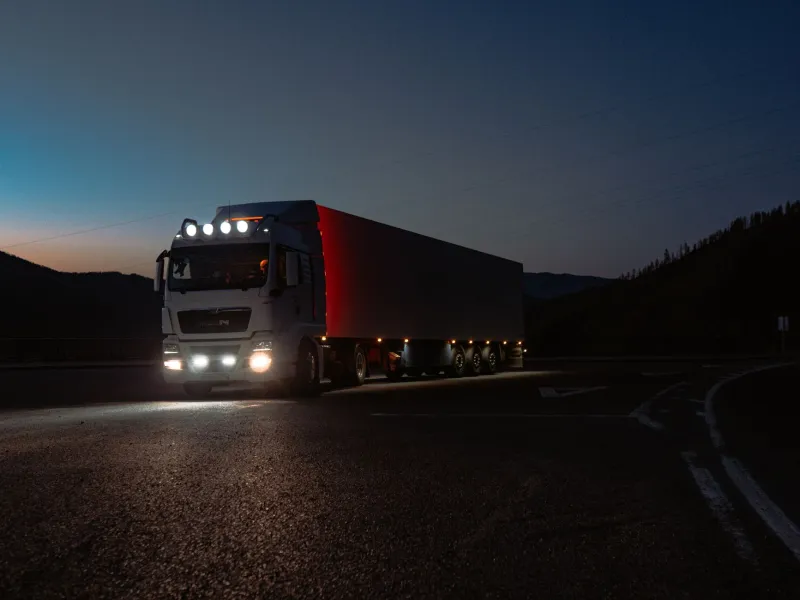
For most fleet managers, the operational day follows a predictable rhythm. Morning briefings, midday check-ins, end-of-shift reports. Dashboards are reviewed, exceptions are flagged, and the team adjusts accordingly. But somewhere between 11 p.m. and 5 a.m., that rhythm breaks down—and with it, much of the visibility that makes modern fleet management possible.
Overnight operations are not a niche concern. Across industries including freight logistics, medical supply distribution, utility services, and food and beverage delivery, a significant portion of the American commercial fleet runs during hours when supervision is minimal, traffic is sparse, and the consequences of poor decision-making are amplified. Yet the monitoring frameworks most organizations rely on were designed with daytime operations in mind.
The result is a visibility gap that costs businesses more than they realize—and one that real-time telematics is uniquely positioned to close.
The Oversight Illusion
There is a common assumption embedded in fleet management culture: that overnight shifts are simpler. Fewer vehicles on the road, less congestion, more predictable routes. On the surface, that logic holds. But simplicity of traffic conditions does not translate to simplicity of operations.
Without active supervision, driver behavior tends to drift. Extended idling becomes more common. Unauthorized stops—at convenience stores, rest areas, or personal addresses—go unrecorded. Vehicles are sometimes used for purposes that fall well outside their assigned routes. In a daytime environment, a dispatcher or supervisor might catch these deviations quickly. At 2 a.m., they often go unnoticed until the following morning, if they are noticed at all.
Dwell time is another underappreciated problem. Overnight delivery windows are frequently longer and more loosely defined than daytime equivalents, which creates opportunities for vehicles to sit idle for extended periods without any operational justification. Fuel burns. Engine hours accumulate. And without real-time data, fleet managers have no mechanism to distinguish a legitimate loading delay from a driver who has simply stopped for an unauthorized break.
Safety Risks That Daylight Hides
Fatigue is the most obvious safety risk associated with overnight fleet operations, but it is far from the only one. Reduced ambient visibility changes the physics of driving in ways that demand different behavioral standards. Reaction times to road hazards are longer. Depth perception is compromised. And the relative absence of other vehicles can encourage speed creep—a gradual increase in velocity that drivers may not consciously register.
Telematics platforms equipped with real-time behavioral monitoring can detect these patterns as they develop, not after the fact. Sudden acceleration events, harsh braking, and lane departure indicators are as meaningful at midnight as they are at noon—arguably more so, given the reduced margin for error. When that data feeds into an alerting system with overnight escalation protocols, fleet managers can intervene before a pattern of risky behavior becomes a collision report.
There is also the matter of vehicle condition. Mechanical issues that develop during overnight runs may not be reported until the following shift change, particularly if the driver is uncertain whether the problem warrants an immediate call. A telematics platform that monitors engine diagnostics and transmits fault codes in real time eliminates that ambiguity. The operations center knows about the issue as soon as the vehicle does.
Compliance Does Not Clock Out
Hours-of-service regulations under the Federal Motor Carrier Safety Administration apply regardless of when a driver's shift begins. But compliance enforcement is inherently harder to execute when the compliance team is off duty. Electronic logging devices integrated with a broader telematics platform provide a continuous record of driving time, rest periods, and duty status—data that is available in real time to anyone with appropriate system access, not just during business hours.
Geofencing adds another layer of accountability. Defining authorized service areas, approved fuel stop locations, and restricted zones gives overnight dispatchers—and the automated systems that support them—a framework for identifying deviations without requiring constant manual monitoring. When a vehicle crosses a geofence boundary at 3 a.m., the platform generates an alert. When it does not, the system records clean compliance data that is available for audit or dispute resolution.
This kind of passive compliance infrastructure is particularly valuable in industries subject to regulatory scrutiny. Pharmaceutical distribution, hazardous materials transport, and refrigerated food logistics all carry compliance obligations that do not pause for the overnight shift. A telematics platform that maintains continuous documentation is not merely a convenience—it is a risk management asset.
Turning Off-Hours Data Into Operational Intelligence
One of the less-discussed advantages of robust overnight telematics coverage is the quality of the data it generates. Overnight operations, precisely because they occur in lower-traffic, lower-complexity environments, can serve as a cleaner signal for certain types of performance analysis.
Route efficiency, for example, is easier to measure when congestion variables are removed. If a driver consistently takes a longer path between two stops at 1 a.m.—when traffic is not a factor—that is a meaningful data point about routing habits or vehicle assignment that daytime data might obscure. Similarly, fuel consumption patterns during overnight hours can reveal idling behaviors or mechanical inefficiencies that are masked by stop-and-go traffic during peak hours.
Aggregate overnight data also helps operations leaders make better staffing and scheduling decisions. If the data consistently shows that certain routes are completed faster during overnight windows, or that specific vehicle types perform more efficiently in low-traffic conditions, those insights can inform future planning in ways that improve both cost and service outcomes.
Building an Overnight Monitoring Strategy
Addressing the overnight visibility gap does not require a separate fleet management system. It requires deliberate configuration of the platform already in place. Several practical steps can make a meaningful difference.
First, establish overnight-specific alert thresholds. Behavioral benchmarks appropriate for daytime urban driving may not be the right standards for a highway freight run at midnight. Calibrating alerts to the operating context reduces false positives and ensures that genuine exceptions receive appropriate attention.
Second, define escalation pathways. When a real-time alert fires at 2 a.m., who receives it? On-call dispatchers, safety managers, and automated response protocols should all be defined in advance, not improvised in the moment.
Third, review overnight data as a dedicated analytical category. Bundling overnight performance metrics into general fleet reporting dilutes the signal. Isolating that data for separate review allows patterns to emerge that aggregate analysis would obscure.
Finally, communicate expectations clearly to overnight drivers. Behavioral telematics is most effective when drivers understand that the same standards apply regardless of shift. A culture that treats overnight operations as a lower-accountability environment will produce data that reflects exactly that.
The Hours No One Is Watching
The competitive advantage in fleet management increasingly belongs to organizations that extract value from data other operators ignore. Overnight operations represent one of the most underutilized data environments in the industry—a window of time when the absence of supervision has historically meant the absence of insight.
Real-time telematics platforms change that equation. The hours when no one is watching are precisely the hours when continuous, automated intelligence matters most. Closing the overnight visibility gap is not a luxury reserved for large enterprise fleets. It is a foundational element of responsible, efficient, and competitive fleet management—regardless of when the shift begins.