Thirty-Four Degrees, Four Hours, No Record: The Cold-Chain Gaps Telematics Can Close
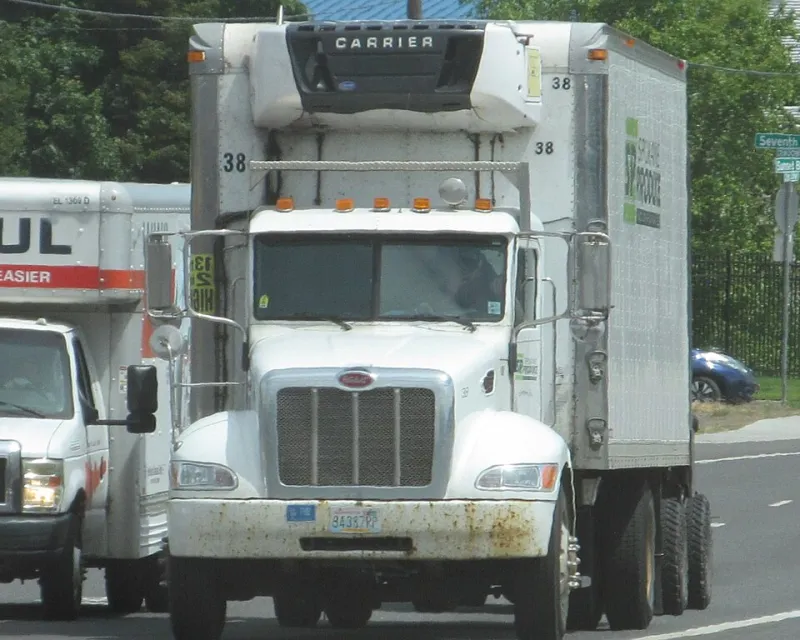
Photo: Ewkada, CC BY 4.0, via Wikimedia Commons
A reefer unit holds a set point. That is all it does. It does not know whether the trailer sat on a sun-baked yard in Fresno for three hours before the driver found it, whether the rear doors were open during a handoff at a cross-dock outside Dallas, or whether the load reached the customer within the window the shipper promised.
When a temperature-sensitive shipment is rejected, the first question is almost always about refrigeration. The more useful question is usually about visibility. Cold-chain failures are frequently not equipment failures at all — they are gaps in the record of what happened to the load between pickup and delivery.
The distinction that matters in a dispute
Consider two shipments that both arrive at 36°F. The first has a clean data trail: loaded at 08:10, doors closed at 08:24, continuous monitoring throughout, delivered at 14:02 with no excursion. The second has a set point log showing compliance but no door events and a forty-minute gap in coverage while the trailer was staged at a yard. The cargo may be identical. The commercial exposure is not.
For food and pharmaceutical shippers operating under US requirements — including the FDA's Sanitary Transportation Rule and, for many medical products, distribution practices that demand documented handling — the difference between those two shipments is the difference between a clean audit and a costly argument.
What the sensor stack can actually attest to
Modern telematics platforms can report considerably more than location. The combination that matters for cold chain typically includes:
- Trailer position and movement, which establishes dwell time at each stop.
- Door open and close events, timestamped and geofenced.
- Internal and ambient temperature, sampled at intervals short enough to be defensible.
- Reefer status and fuel or power state, to distinguish a unit that failed from one that was switched off.
- Route adherence, to identify unplanned stops during a temperature-sensitive leg.
Individually, each of these is a data stream. Combined and time-aligned, they become a narrative that can be produced on demand.
The handoff is where records break
Cold-chain risk concentrates at transitions: shipper to carrier, carrier to cross-dock, cross-dock to final-mile driver, driver to receiving dock. Each transition is a moment when custody changes and, too often, when monitoring stops.
A common pattern is a trailer that is monitored in transit but not while staged. Another is a delivery in which the receiving dock's thermometer disagrees with the trailer's sensor and no shared record exists to resolve it. Real-time telematics does not eliminate these disagreements, but it shortens them considerably by anchoring both parties to the same timeline.
Compliance as a byproduct, not a project
Operators who build temperature visibility primarily for audit purposes often find the operational benefits arrive first. Spoilage claims drop when a carrier can demonstrate that conditions held until the moment of delivery. Detention disputes become easier to settle when dwell time is documented automatically. Loading dock delays surface as a pattern rather than an anecdote.
Compliance documentation, in other words, is best treated as an output of good operational data rather than a separate reporting exercise.
Practical implementation notes
A few decisions shape whether a cold-chain telematics deployment produces usable evidence:
Sampling frequency should match the risk. A frozen goods lane and a vaccine lane do not require the same interval. Define the requirement per commodity before selecting hardware.
Time synchronization matters. Door events, temperature readings, and GPS fixes must share a clock. Unaligned timestamps undermine otherwise solid data.
Excursion logic should be configurable. A brief door opening during a dock handoff is not the same event as a sustained drift. Threshold-based alerting with duration and magnitude parameters produces fewer, better alerts.
Retention should be deliberate. Disputes and audits can arrive months after delivery. Confirm how long records are held and in what format they can be exported.
The visibility gap behind the refrigeration problem
Cold chain will always involve mechanical risk. Compressors fail, fuel runs out, and weather interferes. What fleets can control is how much of that risk is observed in the moment and how much is discovered after the fact by a customer with a clipboard and a rejected pallet.
The gap between those two outcomes is rarely a matter of better equipment. It is a matter of whether the trailer was reporting — and whether anyone was watching the record as it was being written.